


Jiawei Fang, Ruonan Zheng, Xiaoxia Gao, Shifan Jiang, Anjun Chen, Qi Ye, Shihui Guo, Garment Inertial Denoiser (GID): Endowing Accurate Motion Capture via Loose IMU Denoiser,
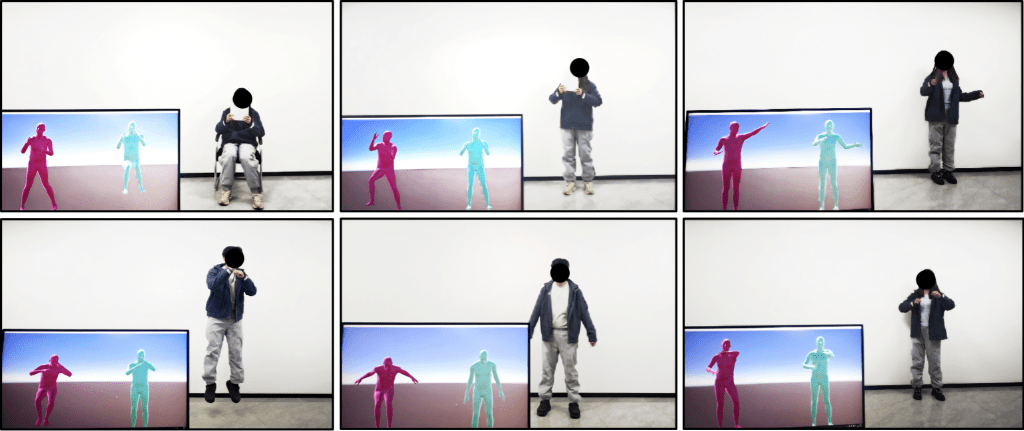
Wearable inertial motion capture (MoCap) provides a portable, occlusion-free, and privacy-preserving alternative to camera-based systems, but its accuracy depends on tightly attached sensors—an intrusive and uncomfortable requirement for daily use. Embedding IMUs into loose-fitting garments is a desirable alternative, yet sensor–body displacement introduces severe, structured, and location-dependent corruption that breaks standard inertial pipelines. We propose GID (Garment Inertial Denoiser), a lightweight, plug-and-play Transformer that factorizes loose-wear MoCap into three stages: (i) location-specific denoising, (ii) adaptive cross-wear fusion, and (iii) general pose prediction. GID uses a location-aware expert architecture, where a shared spatio-temporal backbone models global motion while per-IMU expert heads specialize in local garment dynamics, and a lightweight fusion module ensures cross-part consistency. This inductive bias enables stable training and effective learning from limited paired loose–tight IMU data. We also introduce GarMoCap, a combined public and newly collected dataset covering diverse users, motions, and garments. Experiments show that GID enables accurate, real-time denoising from single-user training and generalizes across unseen users, motions, and garment types—consistently improving state-of-the-art inertial MoCap methods when used as a drop-in module.


Leave a Reply